Identification
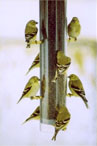
Perhaps one of the most beloved songbirds, what backyard birder hasn’t been thrilled by the sight (photographed at right by Carol Papermaster) of dozens of finches hanging on Nyjer® feeders?
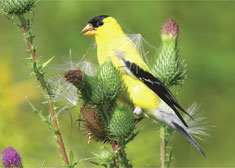
In the summer, the male goldfinch is a bright yellow with a black forehead and wings with white wing bars. The female lacks the black forehead and has a duller olive-yellow color. During the fall, both the males and females molt their bright yellow feathers for ones of a drabber, tan color. But, by early February close observers will note the first hints of yellow starting to show through, a sure sign that spring will eventually arrive. Of interest, goldfinches are one of the only finches who complete two molts a year: one in spring and one in the fall.
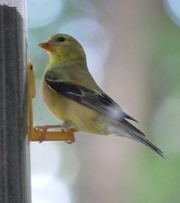
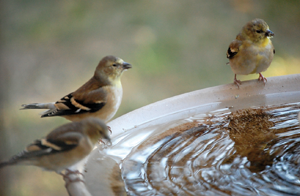
Pictured: Female goldfinch and winter goldfinches
Nesting
American Goldfinches begin raising their broods much later than other songbirds, oftentimes not raising a family until mid-July. Many suggestions have been made as to why, with nesting materials and seed availability for the young leading the theory pack. Goldfinches rely on the soft, white down from wild thistles to line their nests, and Nyjer® seed (or thistle) is their food of choice, although they will add insects every now and then. With thistles not blooming until late June, seeds and down don’t make an appearance until well into July.
Attracting
The goldfinch is found throughout North America, including well into northern Canada and southern Mexico. Even in cold climates, such as Minnesota, goldfinches will be enticed to overwinter with a fresh supply of water, and Nyjer®, black oiler sunflower seeds or our unique Nyjer® and Chips Mix.
Identification
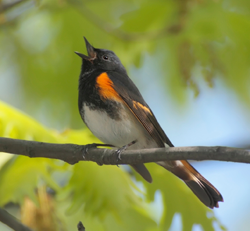
This warbler wears a striking orange and black color combination (male) with a contrasting white underside. Females are muted gray on their heads, backs and wings, with olive-brown and yellow patches on their wings and undersides of their wings. Look for these active birds to be flying acrobatically high up in the treetops, especially in trees with budding leaves. The Peterson Field Guide to Birds of North America describes them as “butterfly-like, with drooping wings and spread tail.”
Habitat and Nesting
The American Redstart is one of just a few warbler species to stay in the Twin Cities Metro Area to breed in the summer. They prefer large, unbroken spans of forest lands. They migrate to Mexico, Central America and South America.
The female redstart builds a cup-shape nest for their single brood. Three to five brownish-white eggs incubate for 12 days before hatching. Nestlings fledge in just 9 days; both parents feed them.
Diet
Like other warblers, American Redstarts are insect eaters, but will also eat seeds and sometimes berries. You may see them come to birdbaths (so keep them filled!).
 Identification
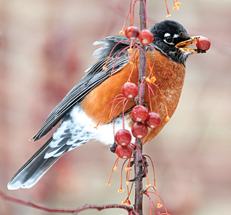
An iconic bird throughout North America, the American Robin is a large songbird known for its bright orange belly. A dark head, white eye circle, gray back and white rump also distinguish this type of thrush.
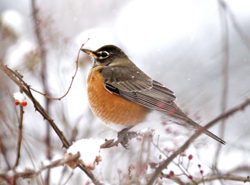 Behavior
Early to rise, you’ll likely hear their lilting song as one of the first on summer mornings. American Robins spend much of the day patrolling lawns for insects and worms or dining on berries from trees, while defending their territories with authority. Though robins will migrate, some may select to over-winter depending on the availability of food and water.
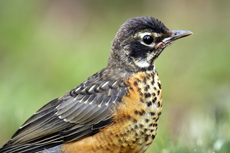
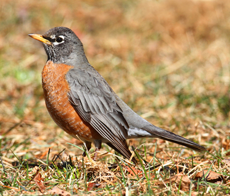
Pictured: juvenile American Robin and female American Robin
Attracting
Robins do not often visit feeding stations, but are frequent visitors to water features and bird baths. Occasionally, robins may be observed dining on grape jelly from oriole feeders or mealworms.
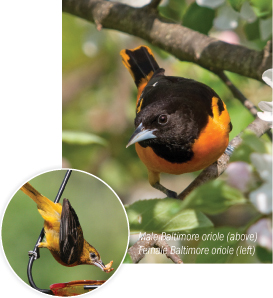
Identification
One of the most striking birds to visit backyards is the oriole. The vivid orange and black coloring of a male Baltimore Oriole is unmistakable and dramatic. While both sexes display a white wing bar, the female’s palette is more subdued, with a dull yellow body and grayish-brown wings. Young orioles appear similar to females in color. Juvenile males molt into their adult orange and black while wintering in Central America. You may hear orioles before you see them: the flute-like call of the Baltimore Oriole is clear and loud.
Oriole nesting and habitat
Baltimore Orioles make their summer home in broadleaf woodlands and forest edges over all of Minnesota—in fact, over most of the eastern United States. A Baltimore Oriole’s nest is quite distinctive; the female weaves a pouch from long strands of plant material on a high branch, very often in a cottonwood here in Minnesota. She then lines it with grass, feathers or even animal fur. Orioles will utilize soft nesting material such as yarn and cotton if offered.
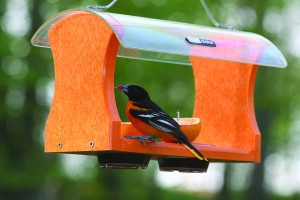 Attracting orioles
Orioles eat insects and fruit and can be attracted to feeders offering nectar, mealworms, grape jelly or fruit. They’re sometimes spotted feeding from hummingbird feeders if they can manage a grip, but prefer oriole-specific nectar feeders which feature larger ports and roomier perches.
Grape jelly or orange halves are good offerings during spring and fall migration. While orioles will continue to visit a jelly feeder throughout the summer, mealworms are attractive to oriole parents; their growing young need the protein. Once the young can fly, the parents will bring them right to the food—which is much easier than the constant ferrying of food the parents do up to this point. Use a dish feeder for jelly or mealworms—or better yet both at once—to make a particularly versatile and successful oriole feeder.
Identifying oriole species
You may encounter Orchard Orioles in open wooded areas in southern and western Minnesota. Orchard Orioles are smaller, have a deep chestnut-red body and sport a black hood and wings. Another oriole species is the western Bullock’s Oriole. These birds look similar to Baltimore Orioles. In fact, older field guides grouped the two species together with the title of “northern oriole”.
Classifying orioles
Orioles are in a group of birds known as icterids. It may surprise you that this group also includes birds that most backyard birders would rather not see—blackbirds, grackles and cowbirds. Compare the outline of an oriole to a red-winged blackbird. You’re likely to notice the family resemblance.
 Identification

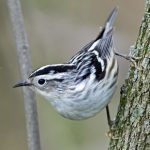
The Black and White Warbler can be easier to identify than its more flitting warbler counterparts, as they tend to move headfirst down tree trunks, branches, or occasionally the side of buildings, in search of insect eggs. Their striking black and white streaked pattern is also a distinctive identifier. Males may also have a black chin (breeding) and cheek patch.
Habitat and Nesting
This early-to-arrive warbler (late April in the Twin Cities Metro Area) prefers to nest further north, throughout the Iron Range and further north into Canada. It favors wooded areas, where females will build a cup-shaped nest and lay 4–5 white eggs with brown markings. The female incubates eggs for a period of 10–11 days; nestlings fledge between 9–12 days. Both males and females help to feed the young.
Diet
Black and White Warblers are insect eaters, but are occasional visitors to birdbaths during spring and fall migration.
About
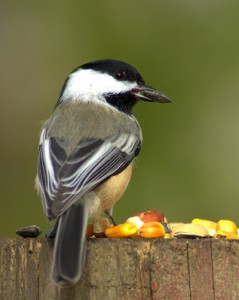
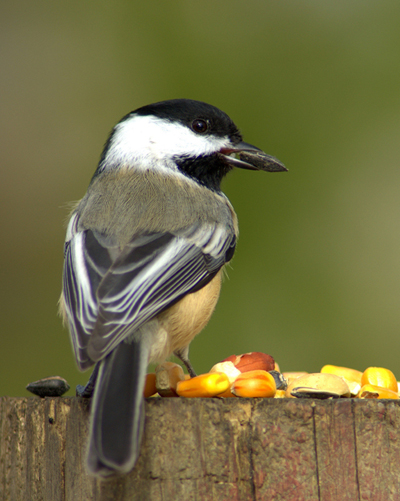
The Black-capped Chickadee is one of our favorite feeder birds—they’re bold, active little feather balls that aren’t shy about sharing their yard with you. Chickadees are often the first birds to explore a new feeder and show the other birds how it’s done. Their territorial fee-bee call can make you smile, as it is a welcome sound of the emerging spring. Their characteristic bouncing flight seems to reflect their light-hearted nature; sort of like the bird equivalent of skipping down the sidewalk.
Behavior
Why chickadees dine and dash with their constant flying in and out, you may think that your chickadees aren’t too fond of your feeder, but don’t be alarmed. These little guys don’t have as strong a cracking action in their tiny beaks as most other feeder birds. They will ferry the seed to a safe spot and either hold it with a foot or wedge it in a crevice and proceed to hammer it open.
 How to attract chickadees
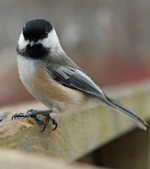
Chickadees will sometimes spend more time on a feeder if there are medium or fine sunflower chips or hearts around. You will also see them visiting feeders stocked with Nyjer® or Nyjer® and Chips. One of our favorite mixes for chickadees is Songbird Delight—lots of medium chips and black-oilers, with peanuts and safflower for good measure.
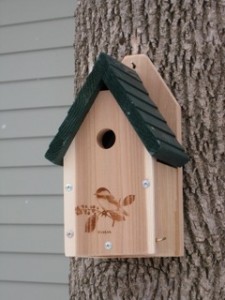 Helping chickadees feel at home

Chickadees will readily use nest boxes and are not particularly fussy as to the style or shape of the house. The size of the hole is important, however. A 11/8″ diameter opening is perfect for chickadees. They will use boxes with holes up to 11/4″ but that larger size tempts house sparrows to take over the box. Nest boxes should be in place by late March or early April so all of your birds can become familiar with them. Your chickadees also appreciate a ball of Best Nest Builder nesting material, as their nest building is part of the courtship ritual.
Identification
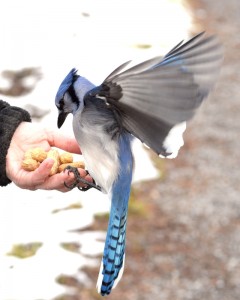
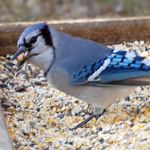
This gregarious and intelligent backyard bird is most easily recognized for its size (about 11 in), color (a bold blue with white spots on its wings and tail), and unique features such as a black “necklace” and crest. The Blue Jay call is loud and frequent, resembling a harsh slurring of the word jeeah.
Behavior
Blue Jays appear to be fearless as they swoop into feeding areas, scattering other birds and even squirrels. When they feed, they’ll often collect a large stash of seeds in their throat pouch, then fly away and hide their treasure before coming back for more. While they can be a bit boisterous at times, the Blue Jay is largely credited for warning other song birds when a predator—like a cat or raptor—are nearby.
Attracting
Blue Jays are most likely to live near edges of forests, suburban gardens and feeding stations. They’re fond of nuts, such as acorns or peanuts. In fact, they’re a blast to watch as they pull a peanut in the shell from a peanut feeder! They’ll also eat a variety of birdseed, including sunflower and safflower seeds, whole and cracked corn, and suet.
Attracting
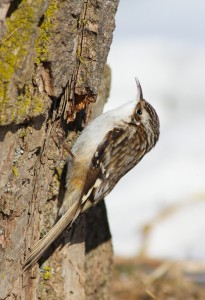
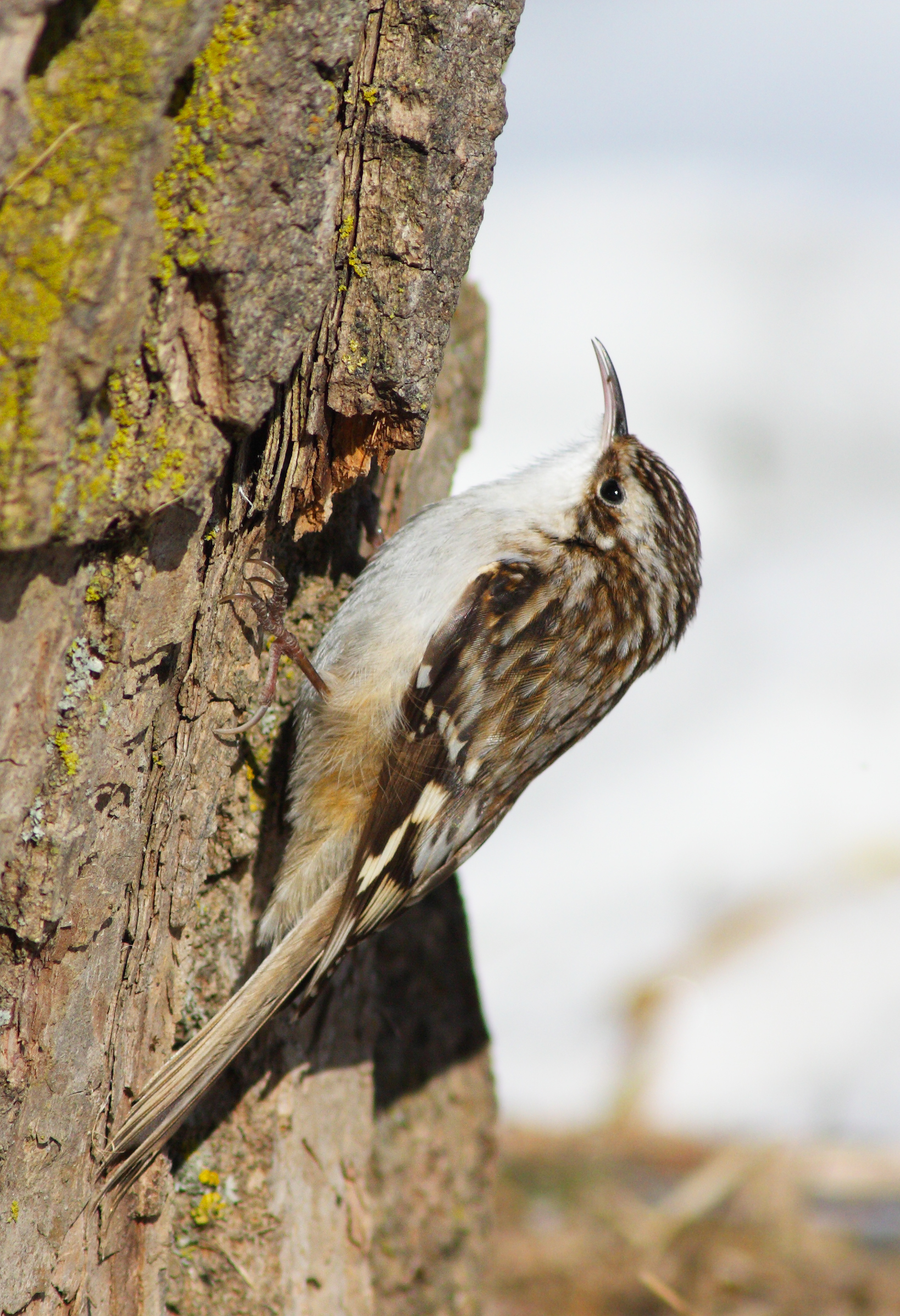
Just like the migrating raptors that prefer to fly down the Minnesota shore of Lake Superior rather than venture above Lake Superior’s water, the little Brown Creeper is very uncomfortable away from the trunks of trees. In fact, I have never seen a Brown Creeper at a bird feeder mounted on a pole or hanging from a branch. That doesn’t mean it can’t happen. But I think it is rare.
Nevertheless, I like to see the little birds around—and you can, too. Simply feed suet from a feeder mounted on the trunk of a tree where visiting Brown Creepers are most likely to approach it (other suet eaters can access it here, too). Creepers live on tiny insects and insect eggs, and generally consume similar-sized morsels of suet. Sometimes they will climb from the foot of the tree up to the suet feeder to eat from the base or sides of the suet. (My feeder is about 5½ feet high and fastened to the trunk by fencing staples.) More often, though, they will just pick up the tiniest of scraps that have fallen to the ground or lodged in cracks and crevices in the bark as a result of the pecking on the suet by woodpeckers and other birds.
Brown Creepers are hard to see, and hard to hear (when you get older), but it is quite satisfying to know that you can help these tiny birds survive Minnesota’s extremes just by offering suet where they are comfortable consuming it.
Contributed by Minnetonka customer Don Grussing, author of The Seasons of the Robin and How to Control House Sparrows
 Identification
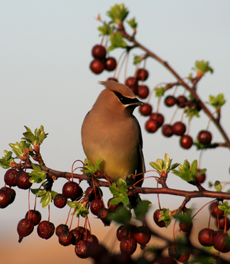
This beautiful golden brown bird with a pointed crest and black mask is named for its red-colored wing tips and yellow-tipped tail, as if it had been dipped in colored wax. Common to Minnesota, this social bird travels in groups in search of berries. You’ll likely hear them (if you can hear high pitches) before seeing them—their voice is a high, “thin lisp” or zeee. Look up when you hear that sound; you’ll likely see clusters of yellowish bellies looking suspiciously like goldfinches in size and color from below. Males and females look alike; juveniles appear grayer with streaks.
Habitat and Nesting
Cedar Waxwings may inhabit Minnesota year-round; they travel in large, nomadic flocks in search of food sources. Look for them in open woodlands, streamside areas and in fruiting trees and bushes (including cedars, the other part of their namesake).
Males and females build a cup-shaped nest, which hosts a single brood (occasionally two broods) per season. Eggs are pale blue with brown marks. Eggs incubate for 10–12 days; nestlings fledge in 14–18 days, with both male and female birds feeding young.
Diet
Cedar Waxwings dine primarily on berries, supplementing with insects as needed. If they’re in the area, they may stop in—en masse!—to take a sip from birdbaths, so make sure to keep them filled!
 Identification

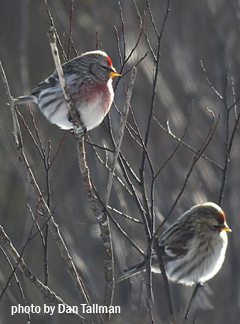
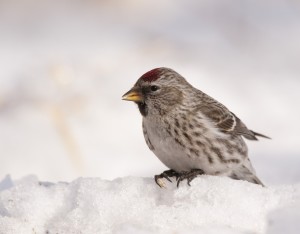
The Common Redpoll is a tiny, fluffy finch that is most often only encountered during the winter by backyard birdwatchers. Related to goldfinches, Common Redpolls are similar in size at about five inches long but with a more compact profile and a small conical bill. Their chests and sides are white with brown streaks, they have some light streaking on their brown backs, two white wing bars, and pale undersides. The name redpoll refers to the red cap they have on their forehead. You can identify between male and female redpolls by the pink wash males have on their chests (it looks a bit like a Purple Finch’s chest markings, sometimes paler).
The closely-related Hoary Redpoll (Carduelis hornemanni) breeds farther north than the Common Redpoll and is identified by a much paler streaking and little if any red color on the breast. Small numbers of Hoary Redpolls sometimes mix with flocks of Common Redpolls during winter.
Range and Habitat
Common Redpolls breed in the far northern boreal forests and taiga regions of Alaska and Canada. This is a circumpolar species, meaning they can be found in similar habitat in northern North America, Russia, and Scandinavia. During the winter, redpolls may move south into southern Canada and the northern half of the United States. This movement, also known as an irruption since it’s not a true annual migration, is prompted by food availability and weather. Redpolls seem to irrupt on an every-other-year pattern but the size and distance fluctuates, some years reaching only Southern Canada, New England, and far northern parts of the Midwest, other years extending farther south throughout the Midwest and Mid-Atlantic states. They will winter in open scrubland as well as suburban areas.
Attracting
Redpolls eat many types of small seeds such as birch and alder, grasses and willows. During breeding they will supplement this seed diet with small insects. In winter backyards they are most often seen at or below finch feeders eating Nyjer®. Look carefully at your flock of winter finches: they are often mixed in with goldfinches and Pine Siskins.
 Identification
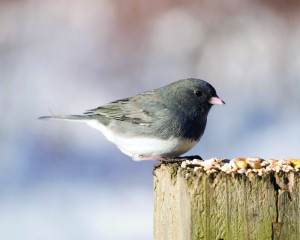
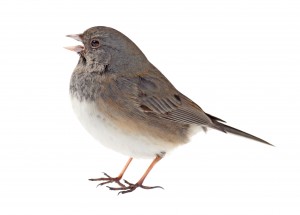
At first glance you may shrug off the diminutive Dark-eye Junco as a bland-colored bird. But upon closer inspection you’ll note that the sleek darker top softly fades to a downy white underbelly. And, if you look real closely, you’ll see that juncos have one of the prettiest beaks; a gorgeous shell-pink that contrasts nicely with its dark hood. When driving your car along rural roads, the sudden flash of white outer tail feathers will confirm you just startled a flock of juncos.
There are five forms, with two other identities possibly becoming forms in the near future. In the Midwest, the Dark-eyed Junco is our “snowbird,” usually arriving six weeks prior to our first significant snowfall. Go ahead: keep an annual log and see how accurate this old wive’s tale is!
 Range
Range
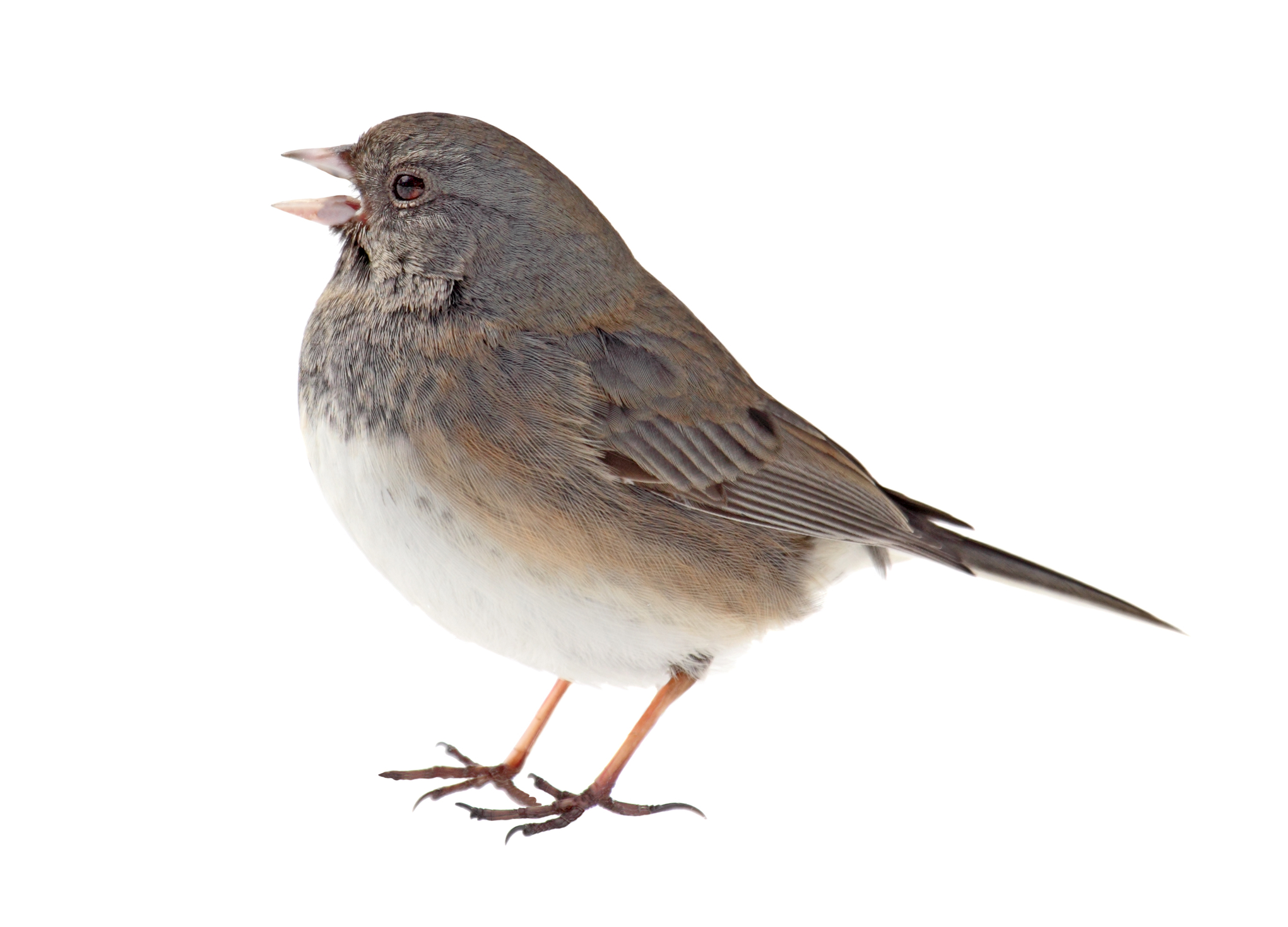
Some form of junco can be found in nearly every state. The slate-colored form can be found throughout Central North America from Alaska south to Texas and east. During the summer months, this form breeds across Canada and into Alaska. It also can be found year-round in the very Northeast tip of Minnesota, near the BWCA (Boundary Waters Canoe Area).
Diet
Fruit and insects are the preferred diet, but slate-colored juncos are feeder birds as well. In fact, during the winter months they are traditionally the most common feeder bird throughout the Midwest. Seeds of choice include millet and Nyjer®.
Identification
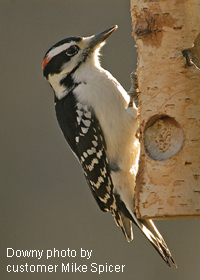
The Downy Woodpecker is our smallest woodpecker. Downys have a black and white spotted appearance with a white belly. The male has a red spot on the back of his head whereas females do not. This woodpecker has a mostly black tail with white outer feathers. These outer white tail feathers will often show black spots on Downy Woodpeckers. The Downy uses its strong, chisel-shaped bill to excavate wood in search of dinner and to make a nest cavity.
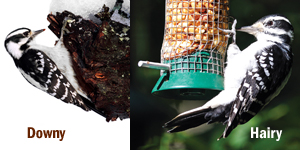 Downy or Hairy Woodpecker?
Downy Woodpeckers look very similar to the larger Hairy Woodpecker. Downies are only about 6–7″ long, just a little bigger than a House Sparrow, whereas Hairies are 9–10″ long, nearly the size of a skinny robin. Size can be difficult to judge so I compare the size of the bill relative to the head. Hairy Woodpeckers have a longer and more substantial bill that is very close in length to the depth of the head. The Downy Woodpecker has a shorter, smaller bill that is shorter than the depth of the head. With practice it becomes easier to tell the two species apart.
Habitat and Habits
Downy Woodpeckers will inhabit any type of wooded area and are one of the more commonly seen woodpecker species. They are permanent residents that do not migrate and their habitat and range covers most of North America. As with all woodpeckers, the Downy uses its tail feathers as a prop, almost like a kangaroo uses its tail, to balance on a tree trunk. Compare this to nuthatches that use only their feet. Like all other woodpeckers, the Downy uses a cavity in a tree trunk to nest.
Attracting
The diet of the Downy Woodpecker consists mostly of insects, even in the wintertime. The woodpecker’s common method of searching within tree bark for bugs is well known though they will also eat berries and nuts if available. A suet feeder or peanut feeder is a great way to entice woodpeckers to a backyard feeding station and they will occasionally come to a feeder stocked with a mix containing sunflower chips or peanuts. A log suet feeder works great not only for Downy and other woodpeckers, but chickadees and nuthatches as well.
 Identification
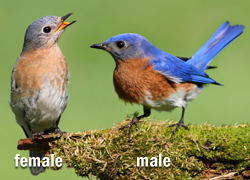
This 7″-long bird has bright blue head, back and tail with a rust-colored breast and white under belly. The female is similar, with a slightly grayer blue on the tail and wings.
Habitat and Nesting
Eastern Bluebirds prefer mixed hardwood forests and grasslands, including meadows, prairies and pastures plus human-made grasslands like cemeteries and golf courses.
Bluebirds typically migrate to southern states in the winter, but some will overwinter in Minnesota, returning in March. They nest beginning in mid- to late April, building cup-shaped nests in existing cavities, including nest boxes. Females incubate 4–5 pale blue eggs for 12–14 days. Male and female Eastern Bluebirds feed their fledglings. Learn about attracting bluebirds and placing a nest box in your yard.
 Diet
Diet
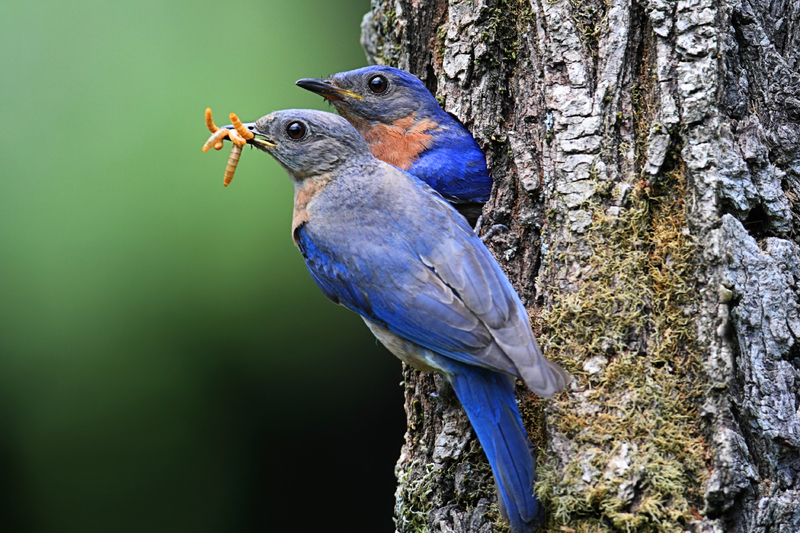
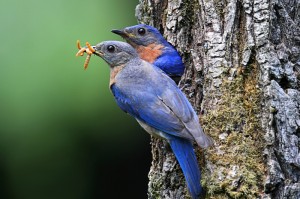
Eastern Bluebirds are primarily insectivores, ingesting spiders, live and dried mealworms, millipedes, caterpillars and other delectable lawn bugs. It is vital to the ongoing health of the bluebird population to provide a pesticide- or chemical-free yard.
During the early spring and late fall, when insects are less plentiful, the bluebirds will dine on sumac seeds and honeysuckle, as well as several types of berries and grapes. They also have been attracted to feeders using nut meats, suet and raisins.
All Seasons Wild Bird Store offers several types of dish-like bluebird feeders, and in our stores we sell the mealworms to use in them.
Want to learn more?
For more information on the Eastern Bluebird, visit the North American Bluebird Society.
 Habitat
Although nonnative, European starlings reside in Minnesota year-round.
Identification
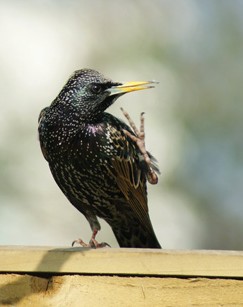
In the fall and winter, starlings are an iridescent purple/black covered with white speckles. As their feather tips wear in the spring and summer, the white speckles disappear, and they take on an all-iridescent purple/black appearance. Their bills also change color: from grayish in the fall, to yellow in the spring. Females and males model the same colors.
Behavior
Starlings are renowned mimics, not only imitating the calls of other birds but also the sounds of ringing phones, family pets and sounds heard around the farm!
Diet
Their diet includes insects, and all the bird seed and suet they can find.
 Identification
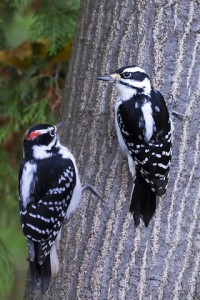
Hairy Woodpeckers are black and white with a white belly. The male has a red spot on the back of his head whereas the female does not. This woodpecker has a mostly black tail with white outer tail feathers. Hairy Woodpeckers do not have spots on these white tail feathers, unlike the Downy Woodpecker. The Hairy has a large, strong bill used for chiseling into wood.
Downy or Hairy?
Hairy Woodpeckers look very similar to the smaller Downy Woodpecker. Hairy Woodpeckers are 9 ¼” long, nearly the size of a skinny robin, whereas Downy Woodpeckers are only about 6 ¾” long, just a little bigger than a House Sparrow. Size can be difficult to judge unless they’re near each other, so compare the size of the bill relative to the bird’s head. The Downy Woodpecker has a smaller bill that is shorter than the depth of its head. Hairy Woodpeckers have a longer and more substantial bill that is very close in length to the depth of its head. With practice it becomes easier to tell the two species apart.
Habitat and Habits
Hairy Woodpeckers can be found in almost any type of wooded habitat though it is most commonly seen in mature woods. They are found nearly all throughout North America, including Canada and Alaska. They will rarely use the narrow branches that the Downy browses on, preferring to keep to the tree trunk and major limbs. They’ll often follow Pileateds, using their holes to rummage for additional insects. As with all woodpeckers, the Hairy uses its tail feathers as a prop, almost like a kangaroo uses its tail, to balance on a tree trunk. Compare this to nuthatches that use only their feet. Hairy Woodpeckers nest in tree cavities.
 Diet
Diet
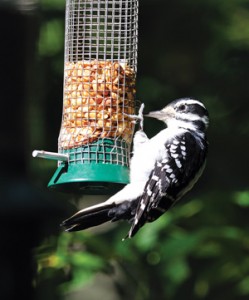
The diet of the Hairy Woodpecker consists mostly of insects, even in the wintertime. The woodpecker’s common method of searching within tree bark for bugs is well known though they will also eat berries and nuts if available. A suet feeder or peanut feeder is a great way to entice woodpeckers to a backyard feeding station and they will occasionally come to a feeder stocked with a mix containing sunflower chips or peanuts. A log suet feeder works great for Hairys and other woodpeckers, and chickadees and nuthatches as well.
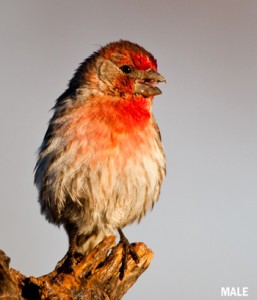 Habits
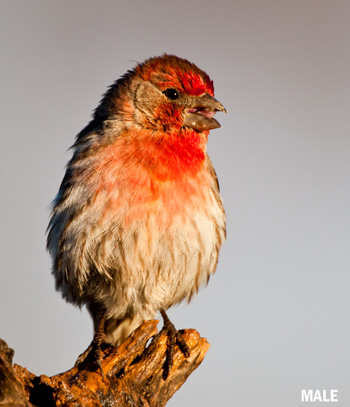
The House Finch has a beautiful song and can often be heard singing. It is a suburban bird and has adjusted well to living among humans. In fact, it’ll often nest in hanging baskets. It will come to nearly any type of feeder as well.
 Nesting
House Finch eggs are small and pale blue and are laid in a loose cup of assorted materials including grass, string, feathers and other items it scavenges in yards. The brood of two to six nestlings will fledge in 11-20 days. So, if you find a pair happily raising a family in your hanging basket, just be patient and you’ll be rewarded with more beautifully singing birds in your yard. House Finches may have as many as three broods a year with both parents frantically caring for the young.
Range
While they were originally found in the Southwest and Mexico, in the 1940s several were released on Long Island and they’ve since spread throughout much of the nation. In the colder regions of the country, the birds will migrate to a slightly warmer climate for a short period of time. They’re often found in Minnesota through December and then return in March.
Diet
They eat seeds, fruit and some insects, and will visit nearly any type of feeder. Interesting fact: the diet of the male House Finch determines the vibrancy of its redness. Brighter red birds have a better chance of finding a mate than duller or orange-cast birds.
Conjunctivitis
House Finches are highly susceptible to conjunctivitis. The disease will cause inflammation leading to blindness. It is not curable and is highly contagious to other birds. For many years, rehabilitators thought the disease was treatable, but studies have found that the disease merely goes into a remission stage and will flare during times of stress. The best way to prevent your House Finches from contracting it is to regularly clean your feeders and bath. If you find a bird with swollen eyes, take it to your nearest wildlife rehabilitation center. In Minnesota, WRC is located on Dale St., in Roseville.
 Identification
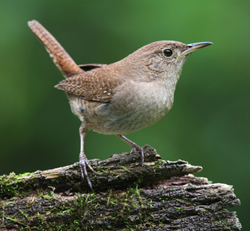
Distinct for its musically rich and bubbling song, the House Wren is a common and delightful bird to host in your backyard. A small bird, the House Wren comes in at just under 5″ long and is brown from beak to tail with slight markings on the tail and wings. It has a slightly curved beak and a light eye-ring. The female House Wren is the same as the male. Look for a flicked-up tail, a common stance for this little bird.
 Habitat and Nesting
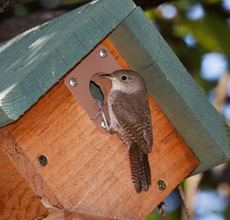
House Wrens have one of the largest distributions of any songbird. (Canada to West Indies, to the tip of Argentina). In Minnesota, they are summer visitors only, migrating to the southern states and Mexico each winter. House Wrens live in a range of habitats, from open woods and thickets, to town parks and backyards. They often nest in bird houses.
Each spring, males return approximately 9 days earlier than females to claim their territory and start a number of prospective nests. When the female arrives, she investigates each nest and chooses one to complete. A nest may contain as many as 500 sticks. Scientists believe wrens also use spider egg sacs in their nests to help reduce the number of mites. The eggs hatch and the baby spiders dine on the mites!
Nests may have 4–6 tan eggs, incubating for 10–13 days with the help of both the male and female wrens. Young fledge in 12–15 days; both parents feed the young.
Diet
House Wrens mostly eat insects, including: beetles, true bugs, grasshoppers, crickets, caterpillars, moths, flies, spiders, plus some millipedes and snails. They are not typical visitors to feeding stations.
 Identification
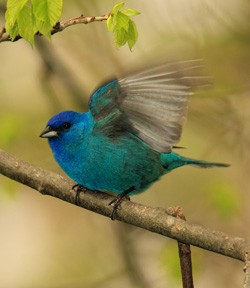
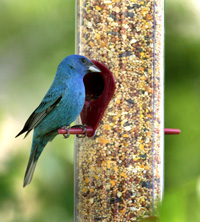
While the female Indigo Bunting sure doesn’t live up to the “indigo” in its title, the male in breeding plumage leaves little doubt about how this bird received its colorful name.
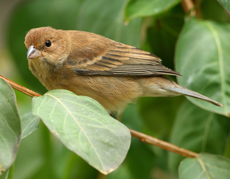 The brown female (right) is most often on her nest and only upon close inspection in the sun will the bluish glint of her back and wing feathers help you distinguish her from a sparrow.
Nesting
Indigo Buntings construct a loose cup of grasses, leaves and animal fur held together with spider silk. The nest is often low in a shrub and hard to detect. Indigo Buntings may have two broods a year, raising 2–6 young each time. They have a short fledging stage, only 9–10 days.
Range
Indigo Buntings are fairly widespread east of the Rocky Mountains and in the southwest. These colorful birds form flocks and winter over in Mexico and Central America. In Minnesota they usually return to their breeding areas in early to mid-May.
 Diet
Diet
Insects are the indigo’s preferred diet and they’ll glean them from leaves and branches. Thankfully for backyard birders, these colorful birds also are easily drawn to Nyjer® tube feeders (they can’t cling to mesh feeders though). They also eat millet, so a mix like Joe’s Mix in a tube feeder or a fly-through style feeder is a good secondary choice. They’ll consume small quantities of berries throughout the year.
 Identification
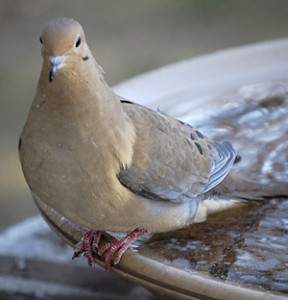
The Mourning Dove is in the same family as pigeons and is easily recognized by its small head, plump body and low-pitched, cooing voice. Its plumage is mostly light brown with darker gray wing tips. You can recognize it in flight by its pointed tail with large white spots. A larger bird at the feeder, Mourning Doves are around 12-in long.
Habitat
These wild doves are abundant in a variety of landscapes, including farms, towns, open woods, fields, scrub, roadsides and grasslands—especially in southern and western Minnesota. Their nests are typically a flimsy platform of twigs placed in coniferous or deciduous trees.
Attracting
Mourning Doves will come to feeders, though they’ll often feed from the ground. Fast yet clumsy flyers, you’ll likely see Mourning Doves practice repeatedly before successfully landing on a new feeder. Their diet consists of seeds (White Millet and cracked corn are favorites), waste grain, fruit and insects.
 Identification
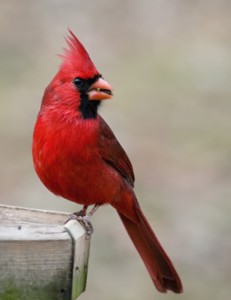
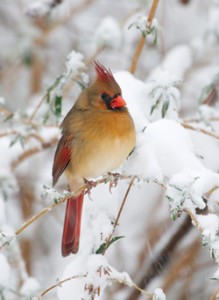
The brilliant red male Northern Cardinal is a splash of color in winter’s drab landscape. He flies from feeder to ground, to birdbath, and back to the feeder while calling a familiar, “chit, chit, chit.” Of all the non-migrating songbirds, the male cardinal stands out the most, with a stark contrast against a snowy background. In addition to his bright red color, the cardinal sports a crested head with a black chin and neck. Even the brown female glows with her red accents and sharp crest. And because they’re year-round residents, their bright red color symbolizes the beauty and warmth of the holiday season.
 Behavior
Being social birds, cardinals travel and feed in flocks of a dozen or more in the winter. They forage for mainly seeds and fruit but supplement with insects. In sharp contrast, cardinals will be in pairs during mating and nesting season. The female will sit on her nest and answer her mate’s call. She is, after all, one of the few female American songbirds that sings. She shares her mate’s calls and adds some that are often longer and somewhat complex.
Attracting
Cardinals tend to be a little skittish, but with patience and the right approach you can soon make them regular visitors to your backyard feeders. They’re ground feeders by nature so start by putting some safflower or sunflower seed on the ground beneath your platform feeder. Be sure to offer water, especially during the winter. Further entice them by providing dense foliage, such as shrubs, pine trees or similar landscape ornamentals. The foliage offers nesting possibilities as well as protection from predators. With the expansion of backyards and the growing interest in watching and feeding birds throughout the years, the Northern Cardinal has thrived in the urban environment. So, invite the beauty of winter into your backyard and enjoy the beautiful cardinal just outside your window.
Article contributed by customer Carolyn Marshall
Identification 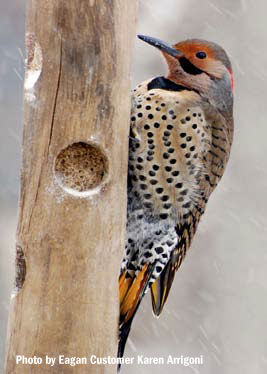
This medium-sized (12″) woodpecker is mostly brown with a black necklace and mustache, speckled breast and a bright red spot on the back of its neck. The Northern Flicker is the only brown-backed woodpecker found in Minnesota.
Behavior
Northern Flickers are the only ground-feeding woodpecker in the United States, but Karen Arrigoni, an Eagan customer, snapped this beautiful photo (left) of one using a suet log . Flickers traditionally migrate, but many will stick around throughout the winter if they have a food source and water.
Diet
Northern Flickers eat insects, especially ants and beetles it plucks from the ground. Their special saliva protects them from ants’ acidic defenses. Flickers will visit suet feeders and may also dine on mealworms, fruit and nut blends at feeding stations.
Identification 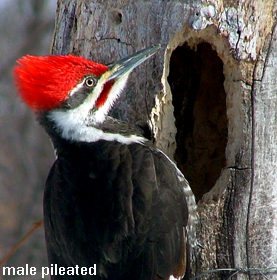
The Pileated Woodpecker is the largest black and white woodpecker in the United States. These birds are nearly the size of a crow with a 30” wingspan. The most obvious feature of the Pileated Woodpecker is its large, red crest. On males the crest is totally red but on females the crest is dark on the forehead and only red toward the top and back of the head. There are black and white markings on the face, starting at the very large bill and extending down the side of the neck. Males have a red “mustache” whereas females do not. The body is all black with a long tail. In flight the wings show white linings. The size and prominent crest of Pileateds make them hard to miss.
Habitat
Pileated Woodpeckers can be fairly secretive birds. This is not to say that they do not appear in backyards, but if you are getting Pileateds to your feeders many folks will be envious. Pileateds prefer large expanses of mature woodland for their territories. They need fairly large trees, at least 16” in diameter, in which to excavate nest cavities. The Pileated Woodpecker ranges over most of the Eastern United States and the West Coast, wherever there are sufficient stands of large trees. A telltale sign of a Pileated’s territory are the large, rectangular holes that the Pileated Woodpecker makes while foraging for insects.
Diet
Insects, especially carpenter ants, make up toe majority of the Pileated Woodpecker’s diet. Their powerful bill allows them to excavate deep into tree bark and heartwood to find insects even in the dead of winter. They will also forage on nuts and berries when they are available. Having a Pileated come to a suet feeder is a great experience. These large birds really prefer to use larger style feeders. Use a double suet cage, or a cage with a “tail prop” so the birds can use their tails to balance like they would on a tree trunk. A log suet feeder also works great if you are being visited by a Pileated Woodpecker.
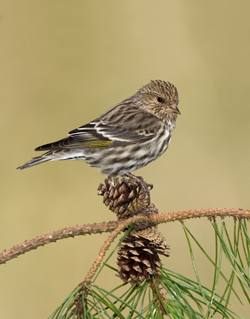 Identification
These occasional winter visitors look a bit like a House Finch, minus the red and with a dab of yellow added to the wings. Both males and females have just a hint of yellow splashed on the outer edges of their wings (males tend to have a bit more yellow).
Watch your flocks of winter finches carefully, they’re most likely made up of siskins, redpolls, juncos, goldfinches and American Tree Sparrows.
Nesting
Pine Siskins stick together in large flocks, even during breeding season, and use their numbers to help protect one another’s nests. Perhaps due to the cold climates in which they breed, the female spends as much as 90% of her time on the actual nest incubating the eggs. The male will bring her food. Of interest, and possibly again due to the cold, hatchlings have a thin downy coat when they’re born (as opposed to many songbirds who are born naked).
Range
Pine Siskins are irruptive, meaning their range shifts as they search for food. Their breeding territory also moves a bit. During years of extended migration, they may choose to stay and breed near their winter feeding grounds. Traditionally, Pine Siskins breed in the far northern reaches of Canada down to the northern Great Lakes region and upper northeast United States, through the Rocky Mountains swath, along the Pacific Coast, and are even found year-round in the mountainous region of western Mexico. Depending on food sources, they will “irrupt” throughout all of the continental U.S., except for the far southern reaches of Florida.
Diet
Flocks 30–40 of finches will descend on Nyjer® seed feeders, quickly emptying them and spilling seed to the other 20–30 Pine Siskins feeding on the ground. One of the greatest sights is a mixed flock of winter finches literally covering the ground under your feeders. They’ll also consume small sunflower chips, supplementing their diet in the summer with insects and tree buds.
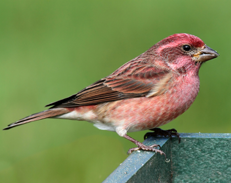 Identification
Most of the raspberry-colored finches we see are male House Finches. However, a few of us may see Purple Finches feeding in nomadic foraging flocks. Look for the lower sides and belly to be “clean” or white (not brown streaked) on the male Purple Finch. The female Purple Finch has a distinctive white eyebrow and white lower cheek patch.
A common misconception is that Purple Finches are purple. Their scientific name, Carpodacus purpureus, may be the source of confusion. Purpureus is actually a Latin word that means “crimson”.
Behavior
Purple finches prefer open woods or woodland edges and are often seen in flocks of up to 50. They’re more subdued than House Finches, which tend to be more active and noisier.
Attracting
Purple Finches mostly eat seeds, particularly those from ash trees. The finches are scattered around the state in the winter, but may visit seed feeders alongside House Finches.
 Identification
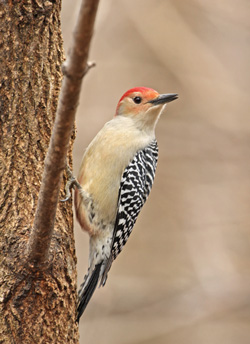
The Red-bellied Woodpecker is a long-billed, heavy-bodied woodpecker, between 9–10″ in length. The head has a red “mohawk” on a cream-colored face. The male’s red cap extends all the way from the forehead at the base of the bill to the back of the neck, while the female only has red on the back of the head. The Red-belly’s back is black with fine white barring with a matching pattern on the tail. The underparts are the same creamy color as the face. This woodpecker has a deeply undulating flight.
Red Belly?
With all the obvious red on the head where does the name Red-bellied Woodpecker come from? It comes from a time when birds were named from collected specimens. If you were to have a dead, or cooperative, Red-Bellied Woodpecker lying on a tray or in-hand you could much more easily spot the reddish wash on the lower underside of the bird.
Habits and Habitat
The Red-bellied Woodpecker is a year-round resident in wooded areas in the eastern half of the United States. This woodpecker has only been a Minnesota bird since the late 1800s, their range has expanded northward slowly over the years and continues to do so. Red-bellieds nest in cavities that both male and female help to excavate. Red-bellied Woodpeckers are very vocal birds. One will often hear their loud churr -ing call before the bird is seen.
Diet
Like other woodpeckers the Red-bellied spends a lot of time foraging for insects in or under tree bark, even during the winter. They will eat berries and tree nuts when they are available. Red-bellied Woodpeckers will frequent suet feeders and peanut feeders year-round. They’ll also eat sunflower seeds, Joe’s Mix or any sunflower seed mix from feeders.
Because of their larger bodies, Red-bellied Woodpeckers prefer larger suet feeders and a log suet feeder is a great way of drawing them to you yard.
 Habits
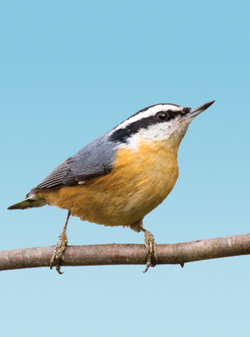
Like other nuthatches, the Red-breasted Nuthatch moves quickly down trees searching for tasty grubs and insects. In fact, the Red-breasted Nuthatch, a winter-only visitor to Minnesota, is much more agile than its cousins and often seems to “flit” through the trees. The male and female are vocal, but you need to listen closely to hear their constant chatter.
Range
Red-breasted Nuthatches nest farther north, west, and higher in the mountains than White-breasted Nuthatches. They may migrate hundreds of miles to the south in the winter if food crops fail in boreal forests.
Diet
Nuthatches consume both seeds, nuts and insects. They prefer pine seeds and will pry open pine cones to extract the tiny seeds. They will come to a feeder for black oil sunflower, chopped peanuts and suet. During the warm months, they feast on insects and insect eggs, including beetles, wasps, and caterpillars.
Identification 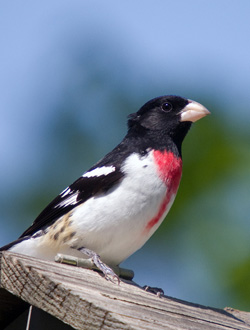
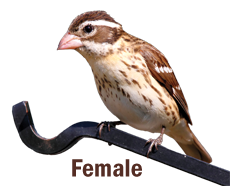
Simply put, there is absolutely no other bird that looks like the male Rose-breasted Grosbeak. The striking color patterns are distinctive. The female Rose-breasted Grosbeak looks nothing like the male. She is brown with white streaks and a white eye stripe. Rose-breasted Grosbeaks are in the same family as the Northern Cardinal. Notice their similar beak shape.
If you live in the northern part of the United States, you’ve probably heard their summer song and thought it was a robin, or maybe an oriole. They have a crystal clear, high warble.
Nesting
Both the male and female grosbeak sit on the eggs to incubate them. Located in trees, shrubs or even woven into vines, the nest is very loosely constructed of sticks, roots, hair, straw and leaves. Grosbeaks typically lay 1–5 eggs and it takes approximately 10–12 days for the nestlings to fledge.
 Range and Diet
These grosbeaks are found only east of the Rockies, with their summer breeding territory ranging from as far south as as parts of Oklahoma and the Appalachians all the way up to Northern Canada. Oddly, they are not found in the Northeastern part of Canada. They winter in Central and South America. Rose-breasted Grosbeaks actually prefer second-growth forests, so their numbers are doing well.
Keeping a fresh water supply and black oil sunflower seeds is a great way to keep these birds in your yard all summer. Grosbeaks also eat large numbers of insects—consuming them similar to the way warblers do—and some fruit.
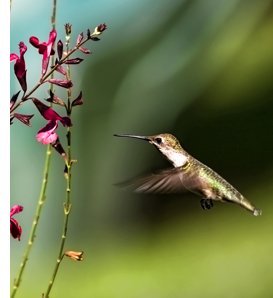 The tiny Ruby-throated Hummingbird easily captures the hearts of backyard birders with its bold, precise movements and bright iridescent colors. Summer visitors, Ruby-throated Hummingbirds complete a migration each spring and fall that seems impossibly far for such tiny creatures.
Identification
Ruby-throated Hummingbirds are only 3–3.5” long with a 4” wingspan. Both sexes sport a jewel-like green coat with a whitish belly. Males feature an iridescent throat that can look dark in certain light. A long, thin bill houses a 15–20mm long tongue with a brushy, textured tip that allows it to quickly lap up nectar.
Nesting and Habitat
Ruby-throated Hummingbirds live in open woodland, parkland, backyards, and meadows. Females build a tiny walnut-sized cup-shaped nest using soft plant material, moss, and a lining of spider webs. Males only stay with the female long enough to mate, but they’ll defend their territory before and after mating. Female hummingbirds typically lay two eggs that look like small jellybeans.
Range
The Ruby-throated Hummingbird is the only species typically seen in the eastern US including Minnesota. Their summer nesting habitat is the eastern US and into Canada; they winter in Central America. The northward migration of Ruby-throated Hummingbirds in spring coincides with the flowering of key plants along their route. Recent studies have also shown that hummers follow the migration of the Yellow-bellied Sapsucker.
 Attracting and Feeding
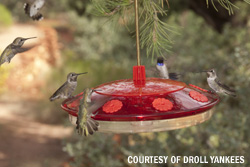
Ruby-throated Hummingbirds consume nectar and add tiny insects for protein. You can supply liquid nectar in a feeder or strategically plant nectar-rich plants such as fuchsia, salvia, zinnias, nicotiana, honeysuckle and petunias to attract these colorful birds. For best results, opt for red-colored blossoms.
Select a hummingbird feeder that’s easy to clean and fill. Many come with bee or nectar guards to help keep insects away from the nectar solution. A natural way to deter insects from nectar is to apply mint extract to the feeding ports.
Place the feeder near perching sites, like trees or shrubs, or near flowering plants. Make sure there’s at least 2–3 feet under your feeder. Hummingbirds are very bold, so don’t worry about putting the feeder too close to a house or window.
For more information, visit our Attracting Hummingbirds page or pick up our Attracting Hummingbirds handout in our stores.
 Identification
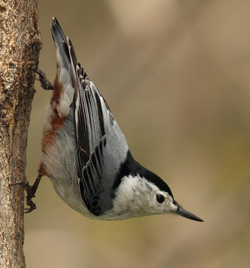
Common to Minnesota, the precocious White-breasted Nuthatch is a natural entertainer, darting quickly and accurately on and off feeders, and hanging headfirst while it feeds. Perhaps mistaken for a woodpecker by their tree-climbing habits, they are smaller and lack the brace of a woodpecker’s tail. Its black cap may be mistaken for a chickadee, but beady black eyes surrounded by white and a longer, narrow beak assist in identification. They are slightly larger (5-3/4 in) and more common than its close relative, the Red-breasted Nuthatch (4-1/2 in).
Habitat
White-breasted Nuthatches are found throughout the state of Minnesota, but are less common in the northeast of the state. They live in hardwood forests, rural woods, and urban/suburban areas where there is adequate cover. Listen for their beep-beep calls high in the trees when walking in state forests.
Diet
White-breasted Nuthatches dine on bark insects, seeds and nuts and can be enticed to come to feeders with suet, sunflower seed, peanut pickouts, and even golden safflower.
 Habits
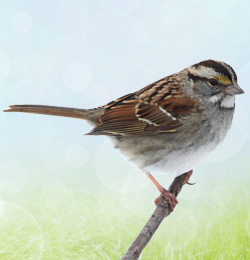
During the breeding season, male White-throated Sparrows merrily sing all day long from brushy woods and lightly wooded thickets.
Identification
Delicate pink legs, a splash of bright yellow around the bill and a grayish beak, set the White-throated Sparrow apart from other sparrows. The yellow is more understated in the fall, but in the spring it’s a brilliant flash between the beak and eyes. The birds look like they’re dressed for dinner, wearing a white cravat at the base of their necks.
There are two color “morphs:” a tan-stripe and a white-stripe. The blackish-tan stripes are set against a duller tan, whereas the white-striped morph has brilliant white stripes set off by deep black bands. The tan morph may have a slightly streaked breast.
Nesting
The White-throated primarily nests in Canada, with some breeding areas dropping into northeast Minnesota, northwest Wisconsin and the Upper Peninsula of Michigan. They can be found year-round in our northern Atlantic states.
Their nest is found on the ground and is a mastery of course bark, moss and grasses on the outside, lined with small soft grass. The eggs are a beautiful blue-white color, and are speckled. White-throated Sparrows usually have one brood a year, but may have two. The eggs take 11–14 days to incubate, with the babies fledging in 7–9 days.
Range
During the winter, the birds tend to stay in more moderate climates than Minnesota; preferring temps above 30 degrees F. They are often found along the Atlantic Coast all the way south to Florida’s Gulf Coast. They seem to be pushing their territory more westward, and may be found in the Southwest and the West Coast.
Diet
White-throated Sparrows prefer insects and seeds, but during the winter will take advantage of fruit left on trees. They are a favorite of backyard bird feeders because they love white millet. All Seasons’ specialty mixes that are perfect for White-throated Sparrows include Cabin Mix and Spectrum. Already have one of these? Try adding a feeder with our Kracker Jax mix. Although it doesn’t have millet, the White-throateds enjoy the pre-shelled sunflowers and cracked corn.